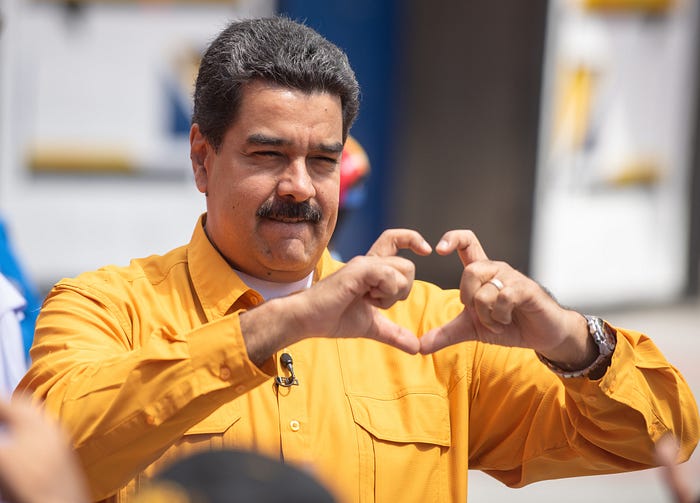
After the United States kidnapped Nicolás Maduro and bombed various locations in Venezuela's Capital, Caracas, many assertions have been made about the Venezuelan President, with many of the claims originating at the US State Department itself. The claims are years old and are being brought back from the dustbin of US policy in Latin America to justify the killing of at least 23 Venezuelans, 32 Cubans, and the attacks on civilian infrastructure and residential buildings.
After a year of creating myriad false narratives about Maduro, it exposed just how quickly and easily it can be done, even when US intelligence reports disagree with outlandish claims being made. The Trump administration has provided no fewer than 8 separate narratives about the supposed tyrant, thus calling into question everything ever said about any so-called US "enemy," especially Venezuela, Maduro, and Hugo Chavez.
So, let's go through some of the nonsensical assertions.
Head of Tren De Aragua
This claim was initially made while Trump was on the campaign trail before the 2024 election. It was used to justify Trump using wartime authorities by suggesting that Maduro was working with the Tren de Aragua gang to infiltrate the United States and attack US citizens at home. As outlandish as it sounds, Trump's base bought it because it confirmed their Latinophobic biases. It later led to the villainization of all Venezuelans and, later, all Latinos, as gang members.
US intelligence reports offered a much different story that didn't include Maduro.
Emptied Prisons and Insane Asylums
This is another claim that began while Trump was on the campaign trail in 2024 and was debunked almost immediately and many times since. Still, that hasn't stopped him or his administration officials from perpetuating the same lie that has been used several times throughout history. Again, his base fed off of it and is weaponizing across all of social media alongside various accounts that have shown support for the attack on Venezuela.
Facilitator of Drug Smuggling
Despite the seemingly insurmountable claims made by the White House against Maduro, alleging he's a facilitator of drug smuggling, intelligence reports by federal agencies came to a much different conclusion. Venezuela was not mentioned as a source of drug smuggling by the Drug Enforcement Administration's (DEA) Annual Drug Report for 2025 or in the United Nations Office on Drugs and Crime's (UNODC) Narcotics maps. The DEA highlighted Colombia as a source of cocaine, and Peru, Ecuador, and Mexico as sources of various other drugs, while the UN spotlighted Colombia, Peru, and Bolivia as major drug sources.
Head of Cartel de los Soles
This is yet another claim that was proven false by US intelligence services. Suggestions about the existence of Cartel de los Soles began as a slang term just before Hugo Chavez was elected. No publicly declared connections to government leaders were made until recent years. A false narrative amplified to villainize Maduro further. The Department of Justice (DOJ) dropped this accusation in its charging documents against Maduro. That in itself is telling.
A Drug Smuggler
Again, an accusation debunked by US intelligence services. Despite the administration and some media outlets still promoting this idea, a declassified April 2025 assessment from the National Intelligence Council (NIC), which represents 17 of the 18 US intelligence services, found no evidence of Maduro being tied to drug smuggling operations or Tren de Aragua. However flimsy the charges against him may seem, the US is clearly out to charge him with the wholly invented charge of "narco-terrorism."
While some (like PolitiFact) have claimed to "debunk" Trump and Secretary of State Marco Rubio's claims about Maduro, they are maintaining a continuously harmful narrative that doesn't address the nuance, thus contextualizing the real story about Maduro and Venezuela. For all intents and purposes, what the US news media is doing is nothing short of propaganda. That they're also whitewashing the firing of intelligence chiefs who wouldn't frame narratives for Trump is also quite telling.
Let's go over the harmful narratives.
But He's a Dictator!
Some will jump on claiming Maduro lost the last election and refused to step down. I suggest pumping the brakes. That may not be the case at all. Many will point to the 2024 elections as evidence of Maduro being a dictator. However, the data they're relying on isn't so reliable. Many questions remain about that election; however, most are centered around the data presented by Machado's opposition party, which shows evidence of forgeries, fraud, and tally sheets that can not be verified as authentic.
In other words, unvalidated. Even the Carter Center, which many cite as proof that Maduro lost the election, deviated from citing the data and focused on other seemingly dubious issues, leading the organization to close its statement by saying, in part, that "voting appeared to take place in a generally civil manner." The Carter Center was invited by the National Electoral Council (CNE) to observe the presidential election and signed a memorandum of understanding "to guarantee that the mission could observe freely in accordance with the Center's standard methodology."
In a separate report, the Carter Center cited the data saying only that, "Opposition poll watchers collected actas from 80% of precincts; those showed challenger Edmundo González Urrutia carrying an over-whelming 67% of the vote," while never saying whether the data was valid. In its final report, the Carter Center excluded the fact that 90% of the tally sheets presented by the opposition lacked certification from poll workers (signature, digital signature, and a thumbprint). Many tally sheets had signatures that were obviously forged, while also lacking certification.
There are more questions than answers about that election. But given the US's history of electoral coups, particularly in Venezuela, the doubts about the opposition's data far outweigh the doubts about Maduro winning the election. Ten candidates participated in the election. All had access to audit the results. Nine of the ten candidates validated Maduro's victory. Machado's party refused to participate with Edmundo Gonzalez, the presumed winner, at one point distancing himself from the data uploaded to the Internet. This context changes views.
Maduro Starved His People
There's no doubt that Venezuela began to experience an economic downturn preceding Hugo Chavez's death and Maduro's taking office. But overlooking how the United States took that opportunity in 2017 to make the situation much worse is harmful and helps drive false narratives. The first Trump administration implemented harsh sanctions on Venezuela, resulting in as much as $31 billion in lost revenue in just three years.
"While the public sector is rife with corruption, it is simply false that none of Venezuela's oil revenue in the years prior to U.S. sanctions was used to facilitate imports," reads a 2020 report from the Washington Office on Latin America (WOLA). In fact, an analysis of the percentage variation in imports and oil exports in Venezuela from 1998 to 2018 shows a close association — meaning revenue from oil exports has long been used to cover imports of everything from food, fuel, medicine, and other basic goods."
The sanctions almost immediately led to widespread food shortages and would inevitably lead to economic collapse and, yep, you guessed it, mass migration out of the country.
Why Did Millions Leave?
This is another common rebuttal. However, as previously mentioned, the sanctions that led to hunger and desperation were the key driver in mass migration out of Venezuela. For context, about 1.5 million people left Venezuela in the 14 years after Chavez took office. After Trump implemented "maximum pressure" sanctions on Venezuela and Cuba, the number of people leaving Venezuela jumped to 2 million in the first year of sanctions, and nearly 8 million to date.
"There is overwhelming evidence (1) that migration is driven in large part by adverse economic conditions and (2) that sanctions can have severe, harmful economic and humanitarian consequences for civilians in targeted countries," reads a 2025 report from the Center for Economic Policy Research (CEPR). "The cases of Cuba and Venezuela demonstrate this relationship clearly: The imposition or tightening of sanctions by the US government have, in recent years, fueled economic crises that in turn have led to record migratory outflows."
Yes, Trump created the mass migration crisis at our border as well as the borders of every Latin American country, where 7 million Venezuelans relocated to. President Joe Biden maintained those sanctions, laying the groundwork for Trump to demonize Venezuelans, accuse them of being hostile invaders, and then bomb the country under wholly created pretenses. When it comes to Latin America and the Caribbean, putting the US boot on the necks of the 670 million people who live there is a bipartisan affair.
Maduro Killed 20,000 People
This claim, like all the others, lacks the context to really put it into focus. The deaths cited in this statistic are extrajudicial deaths at the hands of police and the military over nearly a decade. What it highlights is not that Maduro is responsible for them, but that the systemic issues in Western-style policing are inherent and seen all across the world. Maduro has never been implicated, except in recent US court documents, in directly ordering actions that resulted in extrajudicial murder.
So let's contextualize a little more. In the US, police extrajudicially killed an average of 1,300 people a year for the last ten years, showing a total of about 13,000 in that time. The difference is that in the US, people don't necessarily hold the president directly responsible for those murders. We put the blame where it belongs: on the offender, the policies, and the systemic issues that should be addressed. So why a selectively different standard for world leaders?
Is it fair to say that these murders are Maduro's direct fault? Not necessarily. Could he have done more to help rein in the problem? Maybe. But, as in the US, local and regional leaders, police chiefs, judges, and prosecutors could have and should have as well. The deaths caused by law enforcement agencies anywhere typically speak to broader systemic issues, not unlike the problems we face in the United States and every other country each day.
Conclusion
Is Maduro an asshole? Maybe. He seems like a pretty jovial guy to most people. Is he a crappy leader? That's debatable. Many Venezuelans seem to like him, but here's the thing: outside of Venezuela, we don't have to like him. He's not our problem. If Venezuelans really wanted him gone, in the numbers many are claiming, he would have been gone a long time ago. People who present the twisted narratives mentioned here don't want to admit this, but the truth is that he has a ton of support from the people, as noted by how he moved around with little to no security detail and the fact that he wasn't in hiding from the US.
Venezuela's problems are mostly systemic and, like any other nation, struggles with widespread corruption. Police killings are much worse than they are in the US, exposing the lackluster response by governing bodies to minimize extrajudicial killings. Racism is rampant in far-right political parties like those of Maria Corina Machado, against the mostly Black and Indigenous people, in a society where White Venezuelans are the minority.
You'll also often hear that only the poor support the current government because of subsidies, but in the same breath, they'll tell you that 80% of the population is poor. While poverty is a major concern in Venezuela, we'd be fools not to acknowledge that much of that came from sanctions designed to cripple an already struggling economy and starve tens of millions of people. Even so, Venezuela ended 2025 as the fastest-growing economy in South America for the second consecutive year, finally showing signs of economic progress.
As lawmakers discuss what's next for Venezuela as if they own it, and the mainstream media echoes this ridiculous idea, it's worth noting that they are not giving the Venezuelan people a voice like I and so many others are doing. Venezuelans are proud, and they are as nationalistic about their independence as we are in the US and other countries. To think that nearly 30 million people will accept the same country that has starved them for more than a decade as their friend, you are sorely mistaken. Some might. Most will not.
I ask you: Would you accept a foreign nation invading your country and telling you who your leaders should be? Of course not. You shouldn't expect heavily-armed Venezuelans to either.
I hope corporate-owned news media are listening, but I doubt their owners will allow them to cover Venezuela from this perspective. Corporate media bosses are the same people who benefit from the war machine's actions. Maybe that's why they all spent the New Year at St. Bart's, just north of Venezuela. A watch party, perhaps?
I'm an independent journalist digging deeper into the stories you see or don't see on the news. Find my work at Unicorn Riot, The Antagonist Magazine, Latino Rebels, Orinoco Tribune, and more. I'm also on TikTok, Twitter, Facebook, Instagram, Mastodon, and Threads. To support my work, consider becoming a paid subscriber or making a donation via Venmo, PayPal, or Cash App.