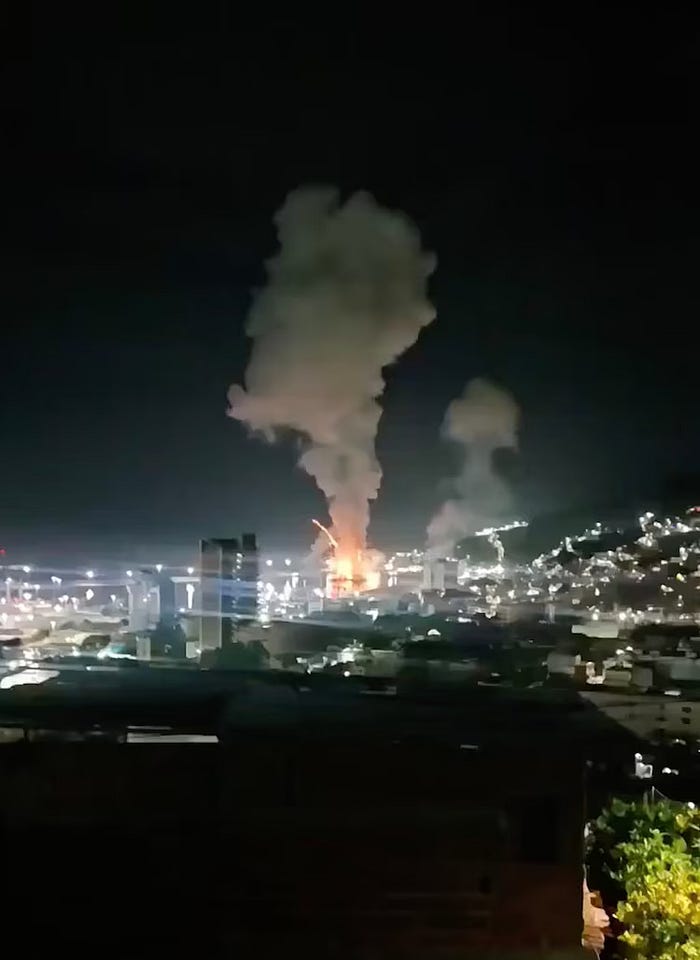
I'm currently in the Antipodes and when I saw the news break I was sickened to my stomach and outraged, as were many millions around the world.
For what it's worth I spent a couple of years on my old boat based in Grenada and the older people there still remember Reagan's invasion with mixed emotions. My regular taxi driver to and from Maurice Bishop airport had a particularly jaundiced view. So did the British Prime Minister as Granada was notionally under British protection, but the US did not consult with the UK beforehand. After Grenada I sailed on to Colombia — it was 2018 and decided to miss out Venezuela due to piracy risks.
In fact, US invasions and CIA operations in the Central and South America are fairly regular occurrences, so I should not have been surprised at the Venezuela news especially as the US forces buildup had been obvious for months. Trump had dropped many clues about his intentions and I'd been following events.
Nevertheless the shock was profound, especially as Trump had come to power promising no more foreign wars and yet he's bombed eight countries since January 20th 2025.
What happened
On 2 January 2026, at 23:46 local time, Trump (I refuse to call him a president) authorised Operation Absolute Resolve.
Here's a official picture of the Trump team at the non-secure situation room in Mar-a-Lago. Say no more.
Anyway, by 02:00 on 3 January, over 150 aircraft conducted coordinated strikes across northern Venezuela, disabling air defences and communications at La Carlota airfield and the El Volcán antenna.
Simultaneously, the United States military disrupted the electrical grid, plunging Caracas into darkness. At 02:01, helicopters carrying Delta Force and FBI personnel descended upon the Fuerte Tiuna military complex. Despite encountering ground fire, the extraction team apprehended Nicolás Maduro and Cilia Flores by 03:29, subsequently transporting them to the USS Iwo Jima for extraction to New York.
Trump declared that the United States would oversee the governance of Venezuela until a political transition is complete, citing the need to restore democracy and secure energy assets (aka steal the oil and minerals).
Russia's sharp condemnation: armed aggression and sovereignty concerns
Yes, it's a bit rich coming from Russia, but this is the nub of their reaction:
The Russian Foreign Ministry issued an immediate and stern rebuke of the American intervention, categorising the operation as an act of naked armed aggression.
Moscow maintains that the removal of a sitting head of state via external military force represents a grave violation of the United Nations Charter and the principles of state sovereignty.
Yes, despite the fact that they have tried to assassinate President Zelenskyy on at least twelve occasions.
Russian officials expressed deep alarm regarding the safety of the Venezuelan leadership and reaffirmed their solidarity with the Venezuelan people. The Kremlin argued that the pretexts used by Washington to justify the strikes were untenable and warned that such actions undermine the foundations of international law.
Iran's outrage: a violation that hits close to home
Tehran denounced the American assault as a blatant example of state terrorism and an affront to the national will of the Venezuelan populace. We might argue about the will of the Venezuelan people given that Maduro ignored the last election, bit their statement about state terrorism holds some water from my perspective.
The Iranian Foreign Ministry asserted that the abduction of President Maduro constitutes a criminal breach of international norms that threatens global peace.
For Iran, this intervention is particularly sensitive given the close strategic and economic ties between Tehran and Caracas. Iranian leaders who are tenuously clinging to power warned that the consequences of this aggression would extend far beyond the Western Hemisphere, suggesting that the United States is attempting to impose its hegemony through illegal force rather than diplomatic engagement. That is a fair point.
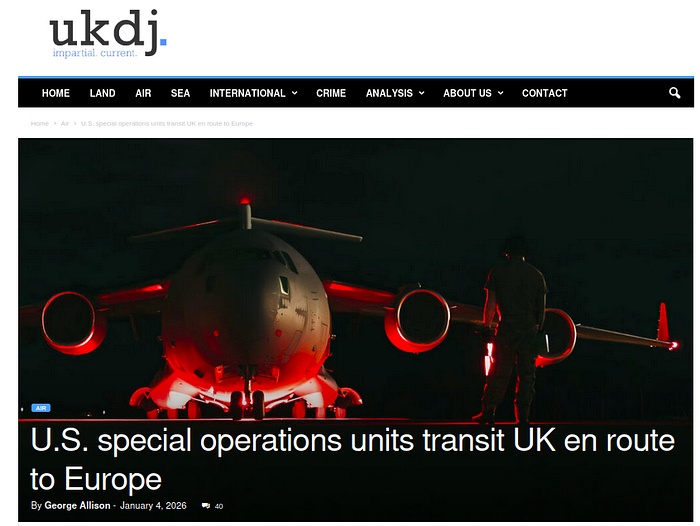
And as I write this there is a huge fleet of US military air transports routing across the North Atlantic to the UK and onward to Europe and the Middle East. This mirrors what happened before Trump bombed Iran's nuclear installations a few months ago.
Shared axis of resistance: how Venezuela bolstered Russia and Iran
Venezuela has served as a critical node in a transcontinental alliance often described by Tehran as the axis of resistance.
This partnership allowed Russia and Iran to project influence into the Western Hemisphere, bypassing American sanctions through the exchange of oil, gold, and military technology.
Caracas hosted Iranian drone production facilities and utilised Russian-derived air-defence systems, such as the S-300VM. This cooperation provided a strategic foothold for Moscow and Tehran to challenge American dominance. The loss of the Maduro administration threatens to dismantle this illicit financial pipeline and remove a key geopolitical ally from the global stage.
Chinese involvement
While the Russian and Iranian responses were framed by security and ideological alignment, the Chinese contribution to this shared axis focused primarily on economic sustenance and infrastructure.
For nearly two decades, Beijing has provided a critical financial lifeline through oil-for-loan agreements totaling over $60 billion. This relationship ensured that the Maduro administration remained insulated from Western financial pressure while granting China a strategic foothold in Latin America.
In the hours preceding the invasion, Maduro met with a Chinese special envoy to reaffirm this "all-weather strategic partnership," which has been central to the regime's survival and its defiance of American regional hegemony.
Venezuela had also deployed Chinese AA radar, which proved useless and highlighted significant vulnerabilities in Chinese military hardware. Reports indicate that the JY−27 and JYL−1 radar systems, marketed by Beijing as "stealth hunters," were effectively neutralised within the first hour of the American assault.
Military analysts suggest that US Navy EA−18G Growlers utilised next-generation jamming technology to "blind" these sensors, preventing the detection of incoming F−22 and F−35 aircraft. This failure was exacerbated by a lack of spare parts and poor maintenance, with approximately 60% of the radar fleet estimated to have been non-operational before the strikes began.
Echoes in Ukraine: Putin's precedent argument
The Kremlin intends to utilise the American intervention in Venezuela to bolster its own justifications for the ongoing conflict in Ukraine. Russian officials argue that the United States has no moral or legal standing to criticise foreign interventions while simultaneously conducting regime-change operations in South America.
By acting without a mandate from the United Nations Security Council, Washington has, in Moscow's view, validated the use of military force to protect national interests and regional security.
This development allows Russian propaganda to paint the invasion of Ukraine as a consistent application of the same "might makes right" logic employed by the Americans.
It's also worth noting that Trump acted without the approval of Congress.
Middle East repercussions: warnings for Tehran and proxies
The rapid removal of the Venezuelan leadership serves as a stark warning to the Iranian government and its regional proxies, including Hezbollah. The effectiveness of the American strikes against sophisticated air-defence systems suggests a high level of military confidence that could be applied to Iranian nuclear or military sites.
Furthermore, the capture of a high-profile ally has sparked domestic debate within Iran, where some segments of the population view the event as a potential precursor to similar actions against the Islamic Republic.
Tehran now faces the reality that the United States is willing to pursue regime change through direct kinetic action and the build-up of forces may be underway as Iran is struggling with siginificant internal unrest.
Implications
The American occupation of Venezuela risks long-term entanglement in a complex civil transition. While the capture of Maduro was swift and well-executed, the subsequent task of rebuilding the nation's "broken" oil infrastructure and establishing a stable government remains fraught with difficulty.
Globally, the move signals a shift towards a more transactional and erratic US foreign policy that prioritises national interests over traditional alliances.
This approach may inadvertently drive smaller nations to seek protection from China or Russia, fearing similar unilateral actions.
Additionally, the disruption of Venezuelan oil production could trigger significant volatility in global energy markets and insurance costs although output is currently low and a significant increase will take several years to achieve.
Conclusions
The invasion of Venezuela marks a pivotal moment in 21st-century geopolitics, representing a definitive rejection of the rules-based international order.
While the United States has successfully removed a long-standing adversary, the unilateral nature of the operation has alienated allies and provided rhetorical ammunition to rival powers.
The long-term success of this intervention depends on whether Washington can facilitate a genuine democratic transition without becoming mired in a "forever war" — they have been in a few of those in the last 50 years.
Ultimately, the event reinforces a shift toward a multipolar world where great powers assert dominance within their respective spheres of influence, often at the expense of international law.
Tantalising questions remain
Pre-agreed?
The speed of the American operation has invited significant speculation regarding a possible covert arrangement between Washington and Caracas. Some analysts suggest that Maduro may have negotiated his own extraction to escape an increasingly unstable domestic situation or the threat of internal assassination.
These theories are bolstered by the lack of meaningful resistance from the presidential guard during the raid.
Pre-agreed?
Some geopolitical commentators argue that the intervention might be part of a broader, unstated understanding between Trump and Putin to delineate respective spheres of influence, essentially "carving up" regional dominance to avoid direct confrontation between superpowers.
'You get Venezuela and Greenland, and I get Ukraine'.
And just a few hours after the US invasion, Trump once again threatened Greenland with annexation at the end of an interview with The Atlantic.
Some of Trump's circle are starting to mention Cuba. Marco Rubio's parents fled from the Batista regime. I can imagine the talk now about 'huge development opportunities'.
That carve-up is the possibility that I fear most. I expect to see US military aid for Ukraine tailing off very quickly. Europe is like a headless chicken right now and doesn't know what to do. I believe that the answer is to drastically ramp up European military aid for Ukraine so that Russia can be defeated. Russia must be defeated.
Meanwhile I hope that the general sensible population in the USA is able to install a sane government.
Iran, though, is a thorny problem — as a strategic partner of Russia I cannot but wonder how that fits into a Trump-Putin carve up.
We are living in very dangerous times.
It's a crazy and very sad world but you do have to laugh at times.
I'll now go back to watching events unfold in Iran and Ukraine.