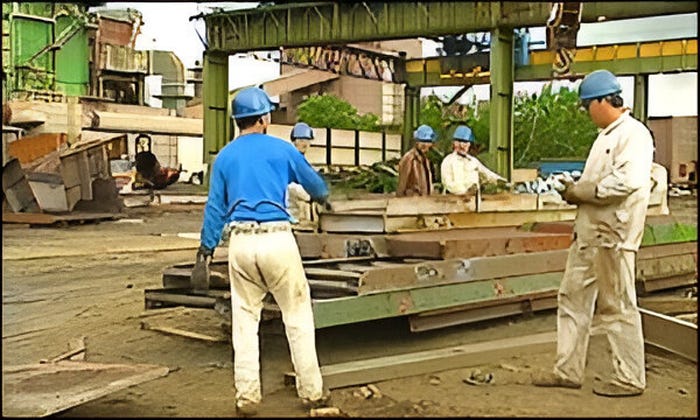
Have a look at the picture below.
This is no stock photo of anonymous industrial laborers.
This is a photo of a huge geopolitical shift.
It was taken in 2002. The workers are Chinese. The place is Dortmund, Germany.
These Chinese workers were there to dismantle the Dortmund-Hörde steel plant, one of Germany's largest steel production facilities. They eventually moved it to China and reassembled it there, piece by piece.
The Chinese workers didn't 'invade' the Dortmund-Hörde. It happened with the full consent of the plant owner, the ThyssenKrupp Group. It was a simple commercial deed.
Rising labor and environmental costs had made local steel production an unprofitable business in Germany. So, ThyssenKrupp decided to sell its Dortmund-Hörde plant.
China was the best-suited candidate for buying it.
After all, in China, labor costs were among the lowest in the world, environmental protection had little value, and the booming local construction industry was steel-hungry.
And above all, it was a win-win situation. China could accelerate its industrial growth, while Germany could shift to cheaper steel imports, reducing expensive homegrown production.
Consequently, China's Shagang Group purchased and relocated the plant to its Handan steel production site, subsequently upgrading it with advanced equipment from other European suppliers to further boost its output capacity.
Today, the Handan Steelworks is among the top steel producers in China. It has created thousands of local jobs and helped China become the global steel superpower.
The craziest part is that over the last two decades, China's steel production capacity has grown so huge that even if the steel output from every Western nation is combined, it doesn't even come near to what China makes.
Back in Germany, the apparent 'win-win' deal soon revealed its other side.
The place where the Dortmund-Hörde steel plant once stood is almost unrecognizable. Not to mention, Dortmund had been Germany's steel-producing and energy-generating economic muscle before the departure of this plant.
In fact, it'd not be wrong to say that the steel and coal industries were the face and pride of this city. And this face and pride don't exist anymore.
The Dortmund-Hörde steel plant had been functioning for almost two centuries. It produced a job boom. At its peak, the plant, combined with the booming coal energy sector, employed more than 75,000 locals.
So, naturally, joblessness in Dortmund increased after 2002. Germany attempted to address this unemployment issue, but the results were not so fruitful. After all, mass job changes for people who have only one specialized skill isn't a good idea.
Now, the site of the former steel plant is home to a recreational artificial lake. Some of the steelworkers once employed there have transitioned to jobs as yachtsmen. But they tell visiting journalists that this new line of work doesn't suit them. They were born for steel, not sails.
So in the long run, this simple commercial deed proved to be a loss for Germany. Today, its steel industry is declining, while that of its adversary has reached new heights.
But zoom out to a bigger picture, and similar simple commercial deeds have now amassed into some of the biggest headaches not just for Germany, but for the whole West.
China, now an undisputed steel hegemon, overproduces steel, and the government subsidizes it. This makes China's steel very cheap.
This cheap steel is then sold to the West, where it hinders the growth of the domestic steel industry. After all, why wouldn't someone prefer cheaper imports from China over expensive local steel?
And here's the even bigger problem: What will happen to the West's infrastructure projects and gigafactories if China suddenly turns off the tap?
US President Donald Trump once summed up this issue precisely:
"If you don't have steel, you don't have a country."
So, selling the Dortmund-Hörde eventually proved to be a big strategic blunder.
And the West's strategic blunders were not limited merely to selling some steel plants.
According to some estimates, the US alone lost almost 2.4 million jobs between 2000 and 2010. These jobs were deliberately transferred to China.
Again, cheaper labor was the key factor. Not to mention the Forbes report that if Apple had continued making iPhones in the US instead of China, they could've cost at least $30,000 each.
When so many critical jobs moved to China, it did more than just boost China's economy. It also slowly started giving China a major technological advantage over the West.
Consequently, now we often hear the rhetoric from the West's political circles that "China stole our jobs."
Well, not really.
China didn't seize these jobs or steel plants by force. These were willingly traded by the West.
If someone is to be blamed, it's the West itself. It didn't see what was coming.
Had the West not sold any of its jobs or steel plants, it wouldn't have felt threatened by China today. It's that simple.
China's only 'fault' is that it didn't 'warn' the West that these simple commercial deeds could make China so strong that the West would live to regret it. That's it.
Not paying any heed to the consequences and blinded by the greed of cheap labor, the West fell into the Chinese 'trap'. China is now well on its way to gaining significant leverage over the West to influence its behavior.
Had the West realized the severity of the issue at least by the 1990s, it would've never sold even a single job or steel plant to China.
But it might be too late. Now, only regret and guilt remain.
And now, to hide its own strategic blunders, the red-faced West is passing the buck. It's framing its own failures as a 'dirty trick' by China.
Knock knock.
A similar story comes to mind, except in that case, the 'dirty trick' was orchestrated by the West itself.
Have a look at the picture below:
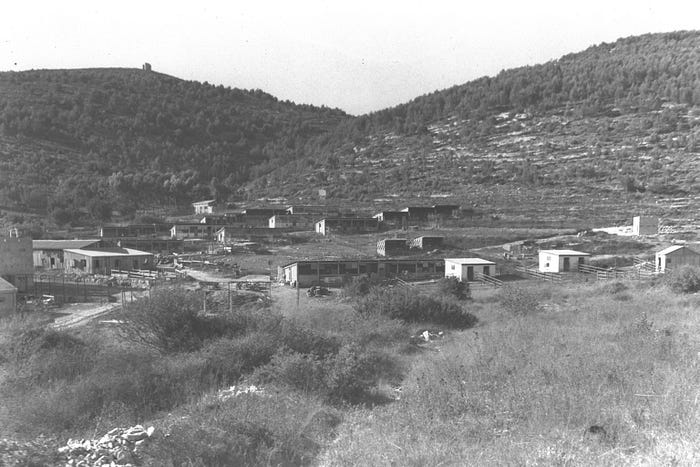
This is no random stock photo of some houses in a hilly area.
This is a photo of a huge geopolitical shift.
This photo was taken almost a century ago. The place had been part of the Abu Gosh village in Mandatory Palestine. The houses belong to the Zionist settlements that would later form the Israeli city of Kiryat Anavim.
Zionist settlers didn't 'invade' Abu Gosh to build their settlements. It was sold by Palestinian politician Musa Al-Husayni. It was a simple commercial deed.
Al-Husayni is believed to have sold many pieces of land to the Jewish National Fund, an organization established in 1901 in Switzerland to encourage Jewish settlements in Ottoman Palestine through land purchases.
In fact, records show that he was designated as a noble on a 1937 Zionist-compiled list of Palestinian landowners who sold property to the Jews.
Al-Husayni might have had no idea that a century later, the same Jewish National Fund would also be gearing up to purchase land in the occupied West Bank, a commercial deed illegal under international law that would worsen troubles for coming generations of his people.
Anyways.
Al-Husayni was not alone. Several Palestinians sold their lands happily and with full consent.
However, it's important to note that these sales were tiny. When the British left, Zionists owned only 4.5% of the land. Of that, only about 1% was sold to them by local Palestinian Arabs. They got the other 3.5% mainly from absentee landlords or as grants from the British government.
The Palestinians who sold their land likely did not foresee that their simple commercial deals were a major strategic blunder. The settlements they themselves enabled would play a huge role in the establishment of the State of Israel. A state that would eventually occupy 100% of their land and put the question of their freedom on the back burner.
At a mere 1%, the land sold by Palestinians was not a big deal, and it was one of the least critical direct factors in the Zionists' claiming the land of Palestine. The military defeats of Arabs and the forced mass migrations of Palestinians were far heavier factors.
But these commercial deeds played a big role indirectly.
First, Zionists successfully amplified these minor land sales into a powerful narrative. They promoted the claim that Palestinian Arabs willingly sold their land, while downplaying the role of military invasion. This created a pervasive myth that is now often repeated: "The Arabs sold the land. Jews didn't invade. Jews bought it with their own money. So Jews have a right to build a state here." It's a narrative now frequently echoed in Western media and widely accepted as truth.
Secondly, unlike land that was taken by force, the purchased areas gave Zionists the time and stability they needed to nurture their culture and develop a sense of nationalism with relative ease.
But by the middle of the Mandatory era, Palestinian Arabs appear to have recognized the gravity of their simple commercial deeds.
That's why the first Palestine Scholars Conference issued a unanimous fatwa (an Islamic religious edict) that prohibited the sale of any land of Palestine to Jews and declared the sellers apostates.
An Arabic newspaper issued a stark warning to its readers, reminding them:
"We are selling our lands to Jews without any remorse… One looks at the quantity of Arab lands transferred daily to Jewish hands, one realizes that we are bound to go away from this country…"
Ironically, the statement then goes on to say:
"But where shall we move to? Egypt, Hijaz, or Syria?"
Soon after, Nakba occurred. And today, the descendants of those same settlers whom some Palestinians initially welcomed are now proposing to send Gazans to South Sudan.
But the realization was too late. Nothing could've been done by then.
Now, only regret and guilt remain.
They didn't realize that the settlers they accommodated would later demand the destruction of Palestinian towns.
They didn't realize that the very settlers they accommodated would one day kill Palestinians openly and then justify those murders.
They didn't realize that the settlers would one day commit a slow, methodical genocide against their future generations. The settlers would deny it, claiming, "Look, this is no genocide; if it were, we would've killed everyone at once with an atomic bomb." And the world would accept this logic, precisely because the violence was slow enough to be disguised.
They didn't realize that the future conflicts with the same settlers would be so devastatingly one-sided, with over 80% of the Palestinians killed being innocent civilians, among them so many women and children.
They didn't realize that the settlers they welcomed would eventually withhold food and starve them, all while openly asking the world not to stop them. And the world will dance to their tunes.
They didn't realize that the settlers they were accommodating would build an army that would one day set a grim record for killing more women and children in a single year than any other recent conflict, and the victims would be none other than their own descendants.
They didn't realize that the settlers would one day wage war on the journalists reporting their suffering, to the extent of killing more reporters than were killed in both world wars combined.
They didn't realize that the settlers' ultimate goal was to eventually remove Palestinians from their land. Nor did they realize that these settlers would then go after their Arab neighbors' lands and openly admit their intentions of forming a "Greater Settlement" with no fear of being stopped.
The Ottoman rulers of Palestine were much smarter. At first, they did not let foreigners buy land there. They seemed to know that if Zionists bought the land, they might someday try to form their own country on it.
But in the 1850s, the Ottoman treasury fell into a spiral of debt and often demanded loans from European countries. The Europeans provided those loans, but asked in return to allow foreigners to purchase land in Palestine.
The Ottomans gave in.