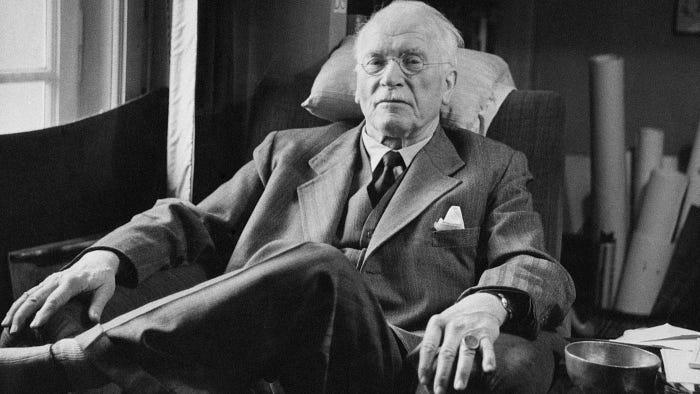
I will be honest. Before I cracked open the Red Book, I'd already decided what it was.
The manuscript had spent decades sitting in a cupboard in Jung's house in Zurich. After he passed, his family moved it to a bank vault in 1984, where it remained for another twenty-five years. It was not published in English until October 2009.
My read on that? The man was embarrassed. Whatever he'd written in there was too far gone, too strange, too much, and he knew it. So he buried it.
I walked in sceptical, and I'll admit that felt like the smart position to take.
I'm not sure it was.
The Book That Took Eight Years Just to Open
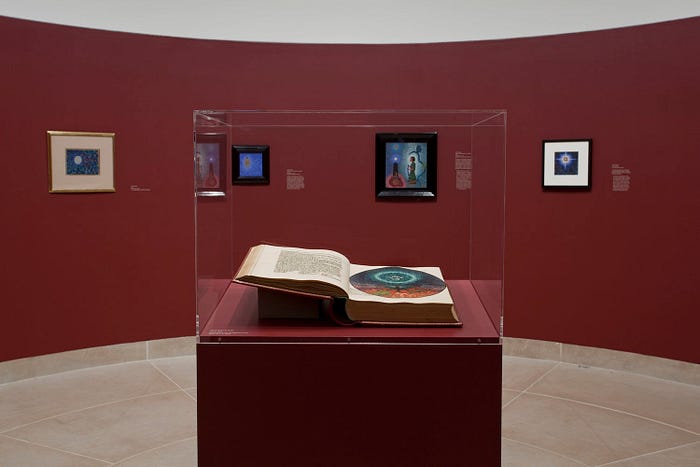
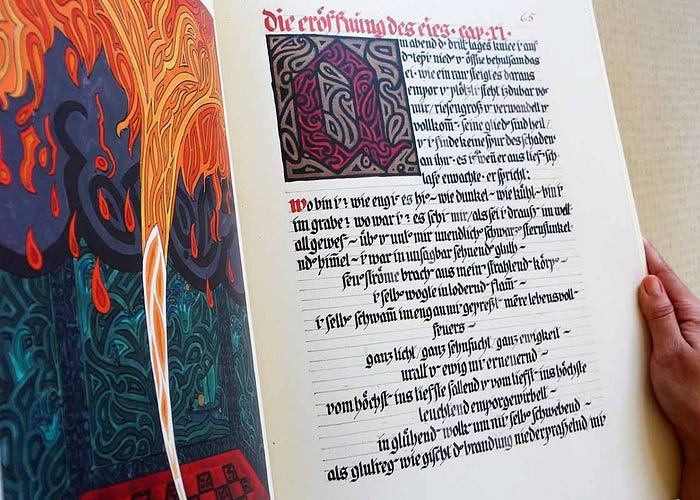
Before you even look at what's actually inside, the Red Book stops you in your tracks just as a physical object. The published version is huge, measuring eighteen by twelve inches and weighing a solid ten pounds. When you open the first half, you are looking at nothing but full-page scans of Jung's original manuscript.
The guy wrote the whole thing by hand in this super thick, ancient Gothic script that gave actual experts a massive headache just trying to decipher. Sprinkled all over the text are these drawings that straight up look like fever hallucinations.
You're looking at these freaky dragons with way too many legs, creatures with goat heads, and just this heavy, unsettling energy, like someone mixed an old medieval bible with a nightmare that wakes you up in a cold sweat.
Sonu Shamdasani, the Jung scholar who actually edited and translated the thing, spent five whole years just decoding the text, and then wasted another three years just begging Jung's family to finally let him publish it.
Eight years. For a single book. That tells you something, though I'm still not sure exactly what.
Jung himself described the Red Book as the source from which "everything else is to be derived."
His whole framework, archetypes, the collective unconscious, individuation, all of it supposedly grew from what he recorded in these pages. He said this privately, not in lectures, not in print. He said it, and then he locked the book in a bank.
That contradiction is the thing you can't shake.
What He Was Actually Doing
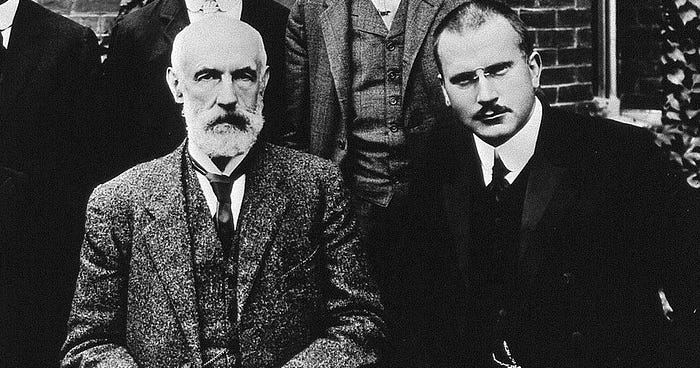
Between 1913 and roughly 1930, Jung went through this intense phase he'd later call a confrontation with the unconscious. He was in his late thirties back then. His huge professional split with Freud had just gone down, and whatever that breakup did to him emotionally, it seemed to open up a floodgate inside his mind that he was just completely unprepared to handle.
He started having waking visions. Not dreams. Not metaphors for something else. Actual experiences, fully conscious, that arrived without warning and felt real to him while they were happening.
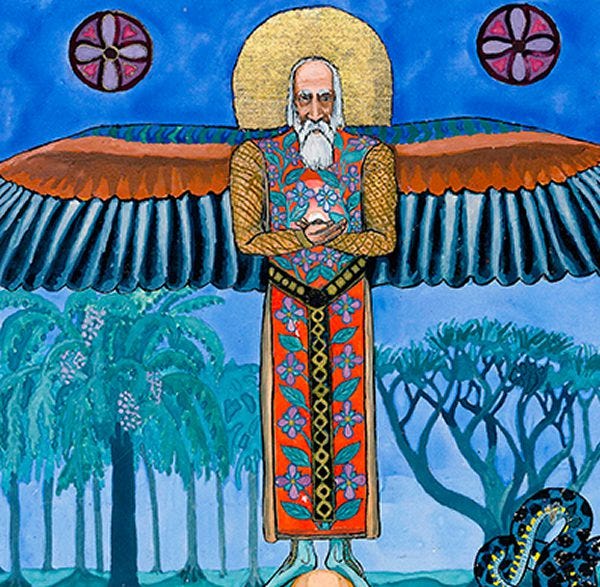
He walked through the countryside near Zurich and held long conversations with a winged figure he called Philemon. He heard a bird-girl speak to him about the first hour of the night and twelve dead men. He saw Europe flooded and buried under a river of blood carrying wreckage and bodies, and this vision came months before the First World War actually broke out.
Jung wrote everything down. In that red leather book. With those illustrations. And then he didn't stop writing for sixteen years.
He was also, during this same span of time, a practising psychiatrist treating patients with schizophrenia. I don't know what to do with that detail, but it keeps coming back.
The Question No One Answers Cleanly
Was he losing his mind? That's what you want to know, and it's worth being direct about it.
Shamdasani's position is no, definitely. At the exhibition that opened around the book's publication, he told the crowd:
"This was no lurid psychosis, this was no psychedelic trip. This was a controlled experiment. He understood what he was doing. This was not someone stripping and running around the lake."
People argue that Jung was just testing out what he later called active imagination. It's pretty much just forced daydreaming to chat with whatever pops up from your subconscious. He didn't bury the weird visions or try to make sense of them right away. He just faced them, had actual conversations, and took notes. Shamdasani is stubborn about this point; it wasn't a mental breakdown. It was calculated. It had a point. It was, honestly, a science experiment.
And yet. The visions were not invited. Philemon didn't appear because Jung sat down and asked him to. He just showed up. The bird-girl spoke without being summoned. The blood river arrived on its own schedule. They were experiences that happened to him, and he was doing his best to keep up.
The psychiatrists writing the DSM-5 back then were actually trying to create a whole new label for exactly this; they called it psychosis risk syndrome. It was meant for people who get these random, repeating hallucinations out of nowhere but still manage to keep their life together and function normally.
Whether Jung would get that diagnosis today rather than a reputation as one of the great thinkers of the twentieth century is a genuinely uncomfortable thing to sit with. And nobody who argues on either side of it sounds completely convincing.
What You Actually Find When You Read It
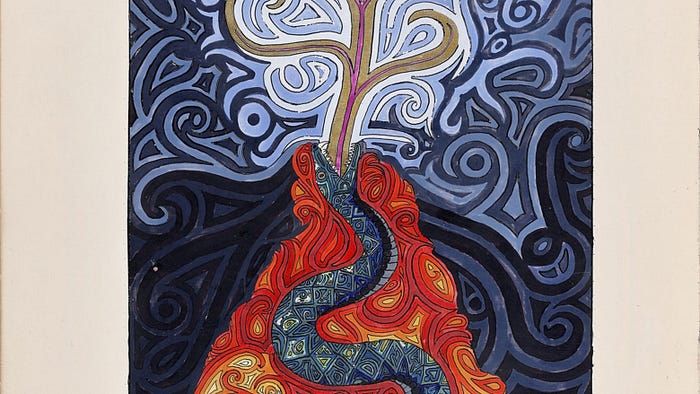
Liber Primus, the first section, reads as Jung wrote himself a Bible. He addresses his own soul directly, treats it as a separate person, female, questions it and follows it into the desert and argues with it when it doesn't make sense. Some of the writing has a real pull:
"Dreams are the guiding words of the soul. Why should I henceforth not love my dreams and not make their riddling images into objects of my daily consideration?" And then a few pages later, the line that I kept coming back to: "You will consider yourself mad, and in a certain sense you will in fact be mad."
By Liber Secundus, the stories start to feel like parables, but without any clear moral at the end. Elijah shows up. So does Salome, famous for requesting John the Baptist's head on a platter. Almost everyone who interacts with Jung in these pages comes out of it worse somehow.
There's a section called Nox Tertia, the third night, where he writes:
"Everything inside me is in utter disarray. Matters are becoming serious, and chaos is approaching."
That doesn't read like a man running a controlled experiment. It reads like a scared man.
The third section, Scrutinies, is Jung trying to figure out what comes after God. Nietzsche had declared God dead thirty years before, and Jung seems less interested in arguing with that than in asking what fills the space. It's the most philosophical part of the book and the hardest to get through without some background in what European intellectual life looked like around 1920.
The book ends mid-sentence. Jung mentions that his growing interest in alchemy had taken him away from the project, and then it just stops. No conclusion. No final image. It's the most unsatisfying ending I've encountered in anything, and also somehow the most accurate one for what the book is.
What I Took Away, and What I Couldn't
I remembered Dr Stephen Martin, a Jungian analyst and co-founder of the Philemon Foundation, which exists to publish Jung's complete and previously unavailable works, and his saying about what a person is supposed to do with the Red Book.
"You're not going to buy the book and say, 'Oh, now I understand everything.' If you want to have an intelligent discussion about the depth of the psyche, you're now going to have to refer to the Red Book. But it will be one of those longstanding processes of trying to understand something that's immensely complex."
The thing that stuck with me more than anything he said was a habit Jung apparently had with his patients. He used to tell them to create their own Red Book.
Take seriously what comes from your interior world. Don't dismiss it as noise. Treat it with the same attention you'd give anything else you were studying. Martin said Jung believed that if you actually did that, your life would change.
I finished the book regarding something I didn't anticipate, which was neither the revelation I'd been told to wait for nor the clean dismissal I'd walked in with. What I felt was more like unease.
The man who spent his career mapping the unconscious more thoroughly than anyone before him was genuinely frightened of what his own produced. Frightened enough to hide it. Frightened enough that it stayed hidden for half a century after he was gone.
He wrote it all down anyhow. That's the part I can't get past.