
I spent four years in college learning things I have never used once in my career.
I don't remember a single formula from my statistics class. I couldn't tell you what my economics professor looked like. The group projects, the presentations, the exams that felt life-or-death at the time have all blurred into a forgettable haze.
But I can tell you exactly which page in The Almanack of Naval Ravikant changed how I think about building wealth. I can recite the core framework from $100M Offers because I have used it to price every digital product I have ever sold. These books didn't just teach me concepts. They rewired how I operate.
College gave me a degree. These four books gave me an education.
#1 The Almanack of Naval Ravikant by Eric Jorgenson
I picked this up expecting another generic self-help book dressed in startup clothing. What I got instead was a complete reframe of how wealth actually works.
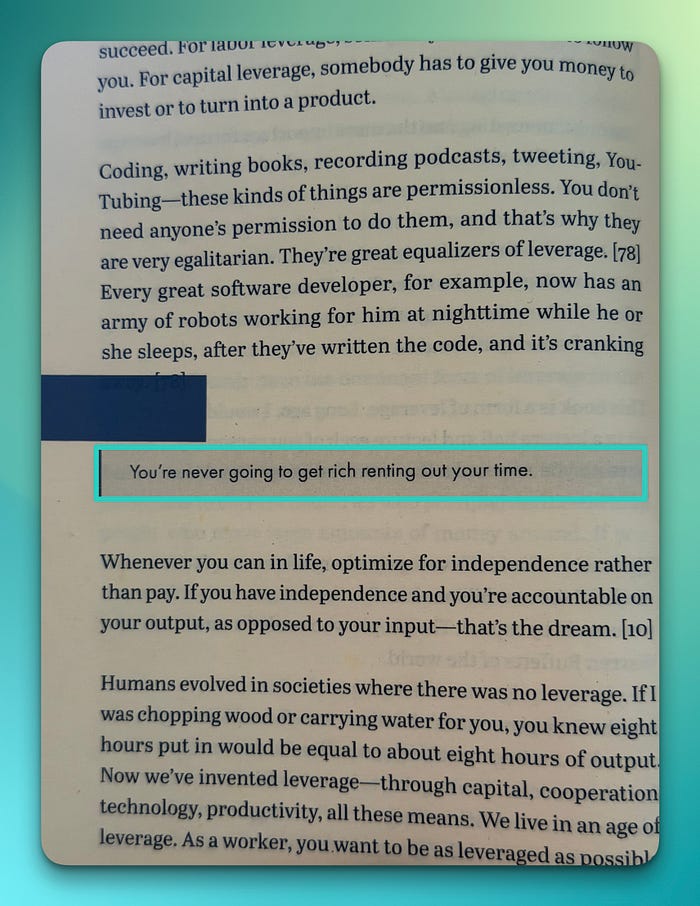
Naval's core idea is deceptively simple: you will never get rich selling your time. The only path to real wealth is owning equity in something, whether that's a business, a product, or assets that grow while you sleep.
College taught me to optimize for a higher hourly rate. Naval taught me that the hourly rate game is rigged from the start.
The concept that stuck with me most is "specific knowledge," which is the stuff you can't be trained for, the knowledge that feels like play to you but looks like work to others.
For me, that turned out to be understanding how people actually use apps, not from a developer's perspective, but from someone who obsessively tweaks their phone setup every week. I thought that was a weird hobby. Turns out it was my specific knowledge waiting to be monetized.
What college never mentioned: leverage.
Naval breaks it down into labor, capital, and products with no marginal cost of replication (code and media).
Writing online is leverage. Every article I publish works for me 24 hours a day, reaching people while I sleep, without me trading additional time. My professors never once explained that a blog post could be an asset.
#2 $100M Offers by Alex Hormozi
This book made me realize I had been pricing everything wrong for years.
Before reading Hormozi, I would look at what everyone else charged and price myself somewhere in that range. It felt safe. It was also stupid. I was competing on price in a race to the bottom, and the bottom is not a fun place to build a business.
Hormozi's framework is almost embarrassingly practical. He breaks down exactly how to stack value so that your offer feels like a steal at any price point.
The equation is simple:
Dream Outcome × Perceived Likelihood of Achievement ÷ Time Delay ÷ Effort and Sacrifice.
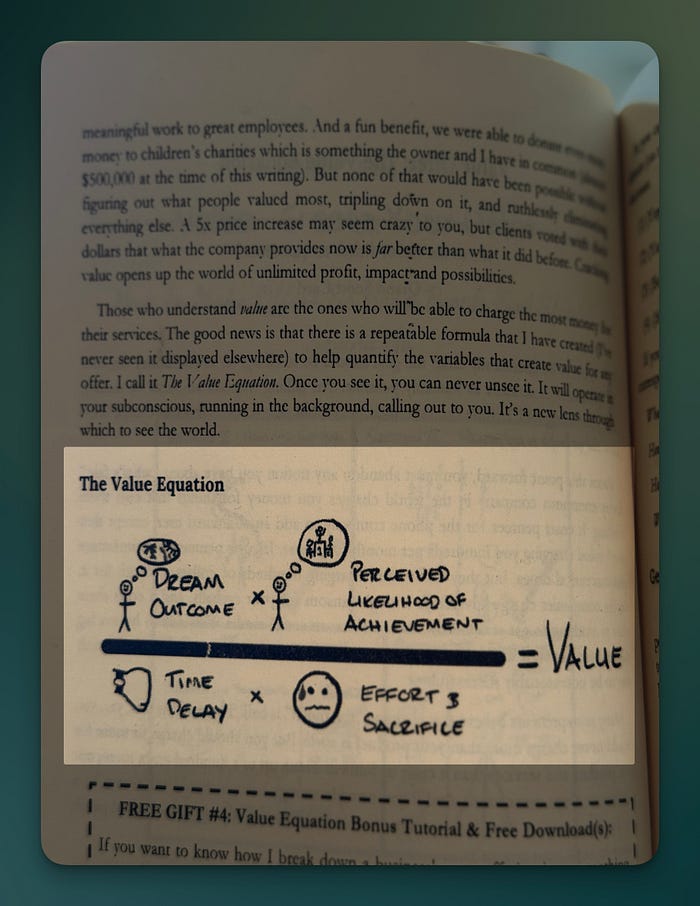
When I applied this to my Craft templates, I stopped thinking about "what's a fair price for a Notion template" and started thinking about what transformation I was actually selling.
The bonuses chapter alone changed how I structure every product launch.
Before, I would create something and hope people bought it.
Now I think about what objections people have before purchasing and systematically eliminate them with bonuses that feel like separate products.
My 2026 Life Planner made over $1,000 in its first week, and I genuinely believe it's because I applied Hormozi's value stacking instead of just slapping a price on a file.
No business class I ever took explained this. They talked about supply and demand curves and market equilibrium. Hormozi talked about how to make someone feel stupid saying no to your offer. One of these is useful.
#3 The E-Myth Revisited by Michael Gerber
I resisted this book for a long time because the cover looked dated and the title sounded like something my dad would read. That was a mistake.
Gerber's central insight is that most businesses fail because the person running them is a "technician" who happens to start a business, not an entrepreneur who happens to have technical skills.
The technician thinks: I'm good at baking, so I should open a bakery. Then they spend 80 hours a week baking, managing inventory, handling customers, doing accounting, and wondering why they ever thought this was a good idea.
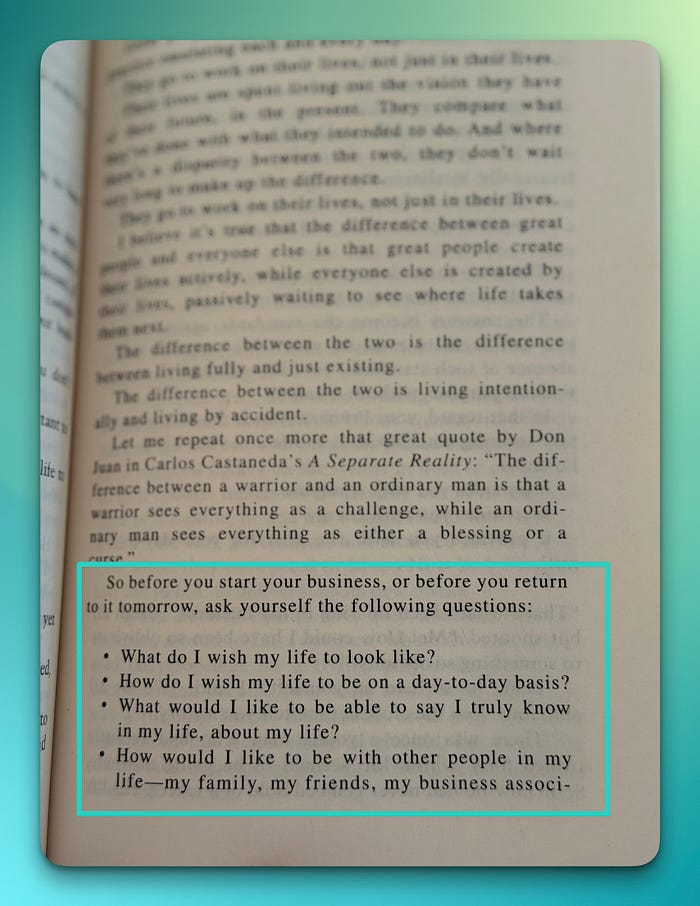
I saw myself in this immediately. When I started taking content creation seriously, I was doing everything: writing, editing, formatting, scheduling, responding to comments, managing emails, handling brand deals, and updating my website. I was the technician working IN the business instead of ON the business.
The book forced me to think about systems. What would this look like if I had to hand it off to someone else? What processes need to be in place so the business runs without me doing every single task?
Even as a solo creator, this mindset shift was massive. I started documenting my workflows, creating templates for repetitive tasks, and thinking about which activities actually move the needle versus which ones just make me feel busy.
College trained me to be a good employee. Gerber trained me to think like someone who builds something that works without constant intervention.
#4 The Art and Business of Online Writing by Nicolas Cole
This book hits different because Cole built his career doing exactly what I do: writing online, building an audience, and monetizing attention.
The book is filled with specific tactical advice that no creative writing class ever covered. How to structure headlines that actually get clicked. Why the first line of any piece is the most important sentence you will ever write. How to think about "endless content" that can be republished and repurposed forever versus "timely content" that dies after a week.
But the insight that fundamentally changed my approach was Cole's framework for "thinking in public." He argues that the internet rewards people who share their learning process, not just their finished expertise.
You don't need to be the world's foremost authority on a topic to write about it. You just need to be a few steps ahead of the people you're helping and be willing to document what you're figuring out.
This gave me permission to write about things I was still learning. I didn't need to wait until I had ten years of experience to share what I knew. The readers who found me weren't looking for a guru. They were looking for someone who was figuring it out in real time and sharing what worked.
Cole also introduced me to the idea that platform matters more than most writers want to admit. Writing into the void of your own blog is romantic but ineffective. Writing where audiences already exist (Medium, Twitter, LinkedIn) and understanding how those platforms distribute content is how you actually build an audience.
My professors would have called this "selling out." I call it understanding how the game works.
What College Got Wrong
Looking back, the gap between formal education and these books comes down to one thing: college teaches you to be valuable to someone else's system. These books teach you to build your own.
College taught me to write essays that impressed professors. Naval taught me that writing online is leverage that compounds over time.
College taught me basic economics. Hormozi taught me how to price something so people actually buy it.
College taught me to work hard on assigned tasks. Gerber taught me to build systems, so I'm not trapped doing every task myself.
College taught me to write "correctly." Cole taught me to write in a way that people actually want to read.
I'm not saying formal education is worthless. It opened doors, gave me a credential, and taught me how to learn.
But the actual skills I use every day to run my business, create content, and build income streams came from books I found on my own, usually recommended by people who were doing what I wanted to do.
If you're building something online, whether it's a newsletter, a product, or a personal brand, these four books will teach you more practical skills in a month than most degrees will in four years.
The best part? They cost less than a single college textbook.