
"What if my company doesn't really do user research?" That's a question designers increasingly ask me, reflecting the reality around user research.
Between AI-powered synthetic research, tight budgets, and more, it can be tricky to be an advocate for user research. But an interesting pattern emerged when I talked with 21 design leaders from around the globe.
Many used an unexpected tool to argue for integrating user research: the business goals themselves.
Here's how they did it.
The Clarity Gap That Designers Don't See
One of the good and bad things is that designers are often empathetic about the user's entire journey. We don't focus on individual user needs: we think about things from start to finish.
That's what UX professionals are trained to do. As a result, it can be very easy to gather dozens of user observations in a single round of user testing.
The problem? Designers don't understand priority. Teams often can't implement 20 different findings at once: they might have the capacity for 3.
So, for many teams, user research equates to getting dozens of pointers on what to improve, but no implementation plan or reason why it matters to the business.
"Understanding the company's goals and how the company makes money — I was not taught that in school. It's not a thing that maybe comes naturally to a lot of designers and researchers." — Carol Rossi, UX Research consultant
The first step to changing that? Understanding how businesses work.
How Businesses Actually Work, and How Design Helps
In simple terms, businesses make bets on how they want to achieve their goals.
For example, if a business's goal is to become the dominant player in the market, or #1 in customer service, that's a great but lofty goal.
So what businesses will do is come up with specific "bets" on how they will achieve that.
One business might focus on attracting new customers who've never heard of it to give it a try and pay for its services.
Another business might focus on getting existing users who visit once a month to visit daily.
Companies make these bets each quarter and try to measure progress toward their goal. But where design leaders get involved is simple: how is what you're designing going to impact the business goal?
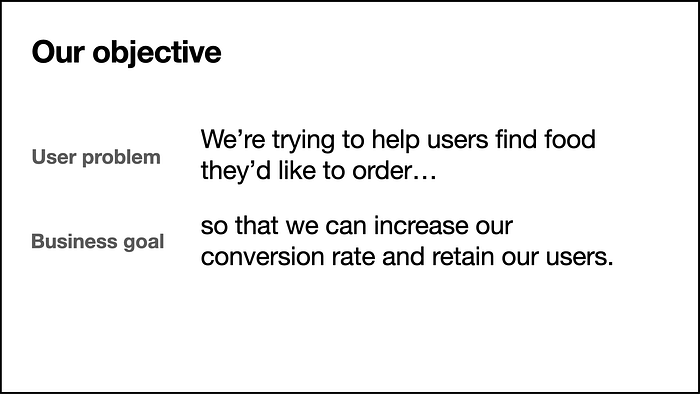
This is what Ben Sauer, in his book Death by Screens: How to Present High-Stakes Digital Design Work, talks about.
He points out that a lot of designers work in environments where businesses haven't connected the dots between:
- "I have this goal around existing customers." and
- This is the designer who's going to build the customer experience that they're going to see every single day and is going to influence how they behave."
When that connection is unclear? Your design work is questioned, you're seen as a pixel pusher, and your requests for user research are ignored.
This is why many design leaders use business goals themselves to pitch user research: You might not have all the answers.
How Business Goals Help You Pitch User Research
The million-dollar question, when you realize that companies are making bets to achieve their goals, is straightforward: Why are users doing what they're doing?
After all, users are behaving in ways businesses don't like.
They're:
- Abandoning the checkout process, which results in lost revenue
- Not clicking to create a new account, which means no signups
- Calling customer support when they get stuck on something that should be simple, which means tons of extraneous support tickets
But what they don't know is why. Even synthetic research or AI tools can only give a generic approximation, and basing million-dollar decisions on hallucinations can be disastrous. Are users:
- Abandoning the checkout process because there are no defaults, meaning they have to run to the other room to get a credit card?
- Just not seeing the create account button because it blends into the background?
- Stuck on one particular step of the installation process, which causes them to call customer support?
This is how design leaders can use that argument to pitch user research strategically:
When you need research:
"Without talking to users, we will not achieve our goals. We only have a best guess at what's driving user behavior — which means our solution may miss the mark."
This approach makes it very clear how "disconnected" user research actually aligns with the business goals they're setting every quarter.
However, that's not the only argument leaders used to talk about the value of research.
When you can skip research:
As Carol Rossi, a UX research consultant, explains:
"Rather than doing a study just because a VP requested it, researchers can say: 'Here's what we already know about that topic — we can save you X dollars by going straight to concept testing.'"
One of the most significant issues UX research faces is that it's often seen as an expense. When you can point out what you already know about subjects, you can showcase how much money you can save by not creating yet another research study.
The key is thinking about impact before you do research. Not every problem needs a new study.
Here's how to get started
Understand that metrics reflect what users do at scale
Many metrics, such as behavioral metrics, track what users do at scale.
Checkout abandonment? That tracks the total number of users (for example, 5 million) who either complete checkout or leave it on a specific page.
When you think of metrics like that, rather than treating them as random numbers, it helps you understand what really matters.
A lot of users are abandoning the site on this page. They're not clicking here, or they're clicking there, or taking a really long time.
These are conversations that you can have with PMs or other people on your team to understand what user behaviors are problematic.
Point out what you don't know
Simply put: if users are behaving a certain way, is there any evidence of why?
If you cannot do user research, there may be other sources, like customer service tickets or support data. But it should be a two-part explanation:
- Here's what we don't know about this or that
- Here are the gaps we have, going from user problem to business goal
User research teams often focus on the first explanation: we don't know about these specific knowledge gaps.
But what many design and research leaders pointed out is simple: by laddering user research up to the business goal, you can easily pitch its value.
It's not that "we don't know why users don't continue the checkout."
It's "Without understanding why users abandon checkout, we might waste a whole bunch of time and money building a solution that doesn't solve the problem."
Change the Perception of User Research at Your Organization
User research is often thought of as a cost center. It' something that requires people to stop development, or a roadblock that makes everyone else wait around.
But often what you need isn't a fancy tool or some charismatic leader. Sometimes the most powerful argument is "we literally do not know this, and this is critical to hitting our goals" in plain language.
Carol Rossi's advice for dealing with stubborn stakeholders drives this home:
"What's important to them, and how can you help them be successful? We can't just keep talking about advocacy and education, because nobody wants to hear that. We need to speak the language that the company is using — what's important to them." — Carol Rossi, UX Research consultant
When you can define how user behavior affects business goals, and you're able to create that logic ladder? That's how you pitch the value of user research.
Kai Wong is a Senior Product Designer and Data and Design newsletter author. He teaches a course, Data Informed Design: How to Show The Strategic Impact of Design Work, which helps designers communicate their value and get buy-in for ideas.