Disclaimer: Please do not repost, republish, screenshot, or share this article or its graphics on LinkedIn or other platforms without my prior permission. Sharing the original link is always appreciated, but reposting the content or visuals without consent removes important context and author control. Thank you for respecting the work and the boundaries around it.
The professional network that promised to connect talent with opportunity has become a graveyard of ghost jobs, fake gurus, and performative hustle porn.
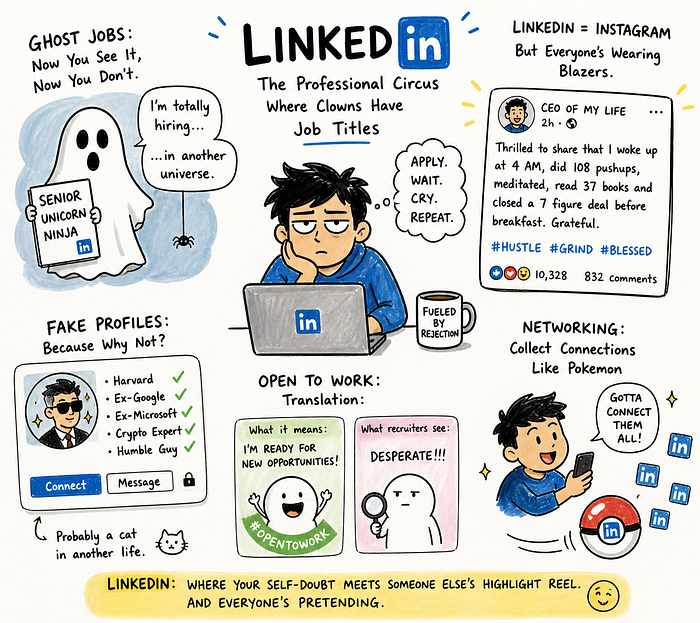
There's a particular kind of despair that sets in when you've applied to 47 jobs on LinkedIn, heard back from three, and then discovered that two of those listings were posted six months ago and the role was filled in January.
Welcome to LinkedIn in 2026 – where the jobs aren't real, the people are half-fake, and the content is indistinguishable from a motivational calendar your aunt keeps in her kitchen.
We need to talk about it.
The Ghost Job Epidemic
Let's start with the most infuriating one.
LinkedIn is drowning in ghost jobs – job postings that are either already filled, don't actually exist, or are being kept live on purpose to create a phantom talent pipeline. A 2025 survey by Resume Builder found that around 40% of companies admitted to posting fake jobs in the previous year. Reasons ranged from "collecting résumés for future openings" to "just wanting to see what's out there."
What this means for job seekers: you're pouring time, emotional energy, and carefully tailored cover letters into a void. You refresh your inbox. You wonder what you did wrong. You rewrite your résumé. The job was never available in the first place.
LinkedIn's algorithm, meanwhile, keeps surfacing these zombie listings as "Active" because companies don't bother – or aren't forced – to take them down. There's no penalty for leaving a filled role posted for six months. There's no transparency indicator showing when a job was actually last reviewed by a human. The platform profits from the appearance of opportunity, even when that opportunity is fictional.
This isn't a bug. It's a business model.
It's Becoming Instagram – But Worse
Remember when LinkedIn was the boring-but-useful place where you updated your job title and occasionally endorsed someone for "Microsoft Excel"?
Those days are gone.
LinkedIn has metastasized into a content platform obsessed with engagement – and the content it rewards is deeply, almost impressively, terrible.
You've seen the posts. The guy who "almost quit everything" but then saw a butterfly and remembered his why. The founder who posts a photo of their private jet and calls it a "lesson in discipline." The woman who cried on the way to work and turned it into a 600-word post about vulnerability that ends with "follow for more leadership insights."
This is hustle porn – the LinkedIn-specific genre of performative ambition dressed up as inspiration. It's Instagram's vanity, Twitter's outrage, and a TED Talk's self-seriousness, all blended into something uniquely insufferable.
The platform's engagement algorithm favors emotional, personal content. So professionals – desperate for visibility in an increasingly noisy feed – have learned to manufacture vulnerability, manufacture triumph, manufacture wisdom. Authenticity has been A/B tested into a content strategy.
The result is a feed that feels less like a professional network and more like a motivational poster factory with a newsletter problem.
The Fake Profile Problem Is Massive
LinkedIn claims over a billion members. But how many of those are real, active, legitimate professionals?
The answer: significantly fewer than a billion.
LinkedIn's own transparency reports have acknowledged removing hundreds of millions of fake accounts – we're talking 85.5 million in just the first half of 2023. These aren't just spam bots. Many are sophisticated fake personas: AI-generated profile photos (you can spot them by the eerily perfect symmetry and suspiciously blurred backgrounds), fabricated work histories, and stolen credentials.
These fake profiles serve several purposes:
- Recruiting scams that collect résumés and personal data
- Investment fraud, particularly "pig butchering" scams where fake personas build trust over weeks before pitching a crypto scheme
- Competitor intelligence gathering, where companies create fake recruiter profiles to extract information from employees at rival firms
- Engagement farming, where fake accounts like and comment to boost content visibility
The FBI has issued warnings about LinkedIn specifically as a vector for financial scams. The platform has become a hunting ground precisely because people trust it. It's professional. It has your real name. It has your work history. The social proof is built in.
And LinkedIn's verification system – despite recent improvements – remains inadequate at scale.
The "Open to Work" Banner Is a Trap
The little green circle saying "Open to Work" was supposed to help job seekers. In practice, it's complicated.
Multiple hiring managers and recruiters have openly admitted – often on LinkedIn itself, with no apparent irony – that candidates displaying the "Open to Work" banner are perceived as less desirable. The logic, as toxic as it is, goes: if they were really good, someone would have already hired them.
LinkedIn knows this perception exists. They introduced a "private" version of the signal that only shows to recruiters, not the general public. But the broader dynamic reveals something ugly about the platform's culture: it incentivizes the performance of success over the honest communication of need.
You can't look desperate on LinkedIn. Desperate doesn't get engagement. Desperate doesn't build your personal brand.
The Influencer Economy Has Corrupted the Feed
LinkedIn now has influencers. Full stop.
There are people with millions of followers who post exclusively about "mindset," "leadership," and "the one thing successful people do every morning." They sell courses. They sell coaching. They sell PDF guides to "authentic networking."
This wouldn't be so bad if the platform didn't actively amplify them over, say, a mid-level engineer sharing a genuinely useful technical breakdown or a job seeker asking for referrals.
The creator economy that transformed Instagram and YouTube has arrived on LinkedIn, bringing all of its distortions with it. Reach now correlates with posting frequency and emotional resonance, not expertise or usefulness. The people who shout loudest about success are often selling the idea of success as their primary product.
Meanwhile, the people who actually need LinkedIn – the ones looking for work, trying to recruit, hoping to make a real professional connection – are sifting through an increasingly cluttered feed to find signal in the noise.
So What Is LinkedIn Actually Good For?
To be fair: LinkedIn remains useful in specific, limited contexts.
- Warm introductions: If someone you know can introduce you to someone at a company you want to join, LinkedIn is where that happens.
- Passively being found: Having an optimized profile helps recruiters find you when they're actively searching – which still happens.
- Company research: Before interviews, it's genuinely helpful for understanding a company's structure and finding mutual connections.
- Niche professional communities: Some industries still have active, substantive discussions happening in LinkedIn groups and comment sections.
But these use cases require you to treat LinkedIn as a tool, not a platform. Dip in, extract value, leave. Don't scroll. Don't engage with the thought leaders. Don't interpret silence after applications as a reflection of your worth.
There's also a strange social layer to LinkedIn now, especially in countries like India, where the platform has quietly become part of how people evaluate status and stability beyond just careers. It's not even uncommon to joke that some parents check LinkedIn profiles before considering an engineer as a potential match for their daughter. Salary progression, company brand names, promotions, certifications, and polished professional photos have become signals of social credibility. In a way, LinkedIn profiles are no longer just resumes. They have turned into public reputation dashboards, shaping how people are perceived not only professionally, but personally too.
The Deeper Problem
LinkedIn occupies a uniquely toxic position because it's one of the few platforms where your identity is your asset and your vulnerability simultaneously.
Your real name. Your career history. Your professional ambitions. It's all there, searchable, indexed, and available to anyone – including the scammers, the ghost job posters, and the algorithm optimizing for time-on-site rather than meaningful connection.
The professional internet deserved better infrastructure than this. We needed a platform that made hiring more transparent, networking more genuine, and professional development more accessible. Instead, we got Instagram with a blue blazer.
The jobs aren't all real. The profiles aren't all real. The inspiration definitely isn't real.
At some point, we have to stop pretending otherwise.
If this resonated, share it with someone who's been staring at a LinkedIn inbox that won't move. They need to know it's not them.
Disclaimer: This article reflects personal opinions, observations, satire, and commentary on online professional culture and digital platforms. It is not intended to defame or target any individual, company, or organization. References to LinkedIn, recruiters, hiring practices, or social media behavior are part of broader cultural commentary based on publicly discussed experiences and personal perspective.