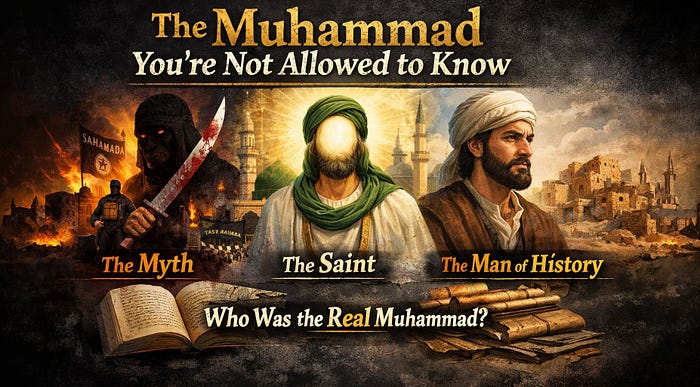
There are three Muhammads. The one the West imagines, the one the Muslim world venerates, and the one history actually recorded. They might as well be three different people.
The Western Muhammad hunts down gay people, executes anyone who dares leave Islam, kills non-Muslims — preferably Christians — in his spare time, and personally pulls the pin for suicide bombers.
The Islamic Muhammad is the most perfect human being ever to walk the earth. He never sinned, never spoke a wrong word, never changed his mind. His alleged personal quotes carry Quranic weight, and questioning any of them is treated as questioning God himself.
The historical Muhammad is more human. He had weaknesses. He admitted wrongdoing. He expressed regret. He was criticized by his own people, including his wife Aisha — and openly. He didn't want to be a second Jesus — he wanted to connect people directly with God without an intermediary. He calls himself the seal of all prophets, but if there's one prophet who stands apart from the rest in the Quran, it's Jesus — the promised messiah, born of a miraculous virgin birth. And that historic Muhammad is a problem, because he destroys the authority of the hadith literature that much of modern Islam is built on — particularly in the parts of the Muslim world where hadith, not the Quran, functionally runs the religion.
Today, we'll be talking about the Muhammad that's suppressed in Muslim-majority countries and never made it to the West in any shape or form.
Today's Muhammad
You wouldn't think it looking at the state of things, but the version of Muhammad that dominates today — the one where any depiction is forbidden, any criticism is blasphemy, and any historical scrutiny is an act of war — is a relatively modern invention. It didn't emerge from the Quran or the laws Muhammad established. It didn't even come from the earliest Muslim communities.
The Muhammad taught to Muslims today, the one they're never allowed to question, came from centuries of political calcification, colonial trauma, and the deliberate theological inflation of a human prophet into something dangerously close to what Islam was supposed to reject: an intermediary between humanity and God who can't be touched by mortal hands.
And the irony is, the Quran itself wouldn't put up with it.
Mocking Muhammad isn't something new. As a political figure and religious leader, he was mocked during his own lifetime, and it seems Muhammad didn't have the thickest skin. But he was too intelligent to issue violence toward these groups, because he must have understood that it was horrible PR — it would've guaranteed Islam a bad name and Muhammad a reputation as a violent man.
So let's start with how the Quran depicts Muhammad and the choices he made. What kind of person he was. Whether God ever told Muhammad he was so perfect that all his words had to be recorded — even the ones that might have been spoken out of anger — and used as an addon to the Quran, sometimes even overwriting it.

The Quran Corrects Muhammad — Repeatedly
One of the most underappreciated aspects of the Quran is how many times it tells Muhammad he's wrong and doesn't do it gently or diplomatically but brutally and directly.
Chapter 80 (Abasa, verses 1–10) opens with God rebuking Muhammad for frowning at a blind man who interrupted him while he was trying to impress Qurayshi elites. It doesn't soften the blow and say "you made an understandable mistake." It says, essentially, who are you to decide who deserves the message? The blind man came seeking guidance, and Muhammad dismissed him because he was more interested in courting powerful people. God wasn't impressed.
Chapter 66 (Al-Tahrim, verse 1) starts with "O Prophet, why do you prohibit what God has made lawful for you, seeking to please your wives?" The details behind this verse are debated, but not the theological point. Muhammad made a ruling based on domestic pressure rather than divine mandate, and God called him out for it.
Then there's the aftermath of the Battle of Badr. Muhammad took ransom for the Meccan prisoners of war. Chapter 8 (Al-Anfal, verse 67) hits him with: "It is not for a prophet to have captives until he has thoroughly subdued the land." Some early commentaries record that when this verse came down, Muhammad and his strongest political ally and father-in-law, Abu Bakr wept — because the rebuke was that sharp.
This is the Quran talking about its own prophet, not enemies of Islam or "Orientalist" scholars. The foundational text of Islam treats Muhammad as a man who makes mistakes and needs correction.
So when did that stop being acceptable?
His Companions Didn't Treat Him Like Glass
The vast majority of Muslims consider Muhammad's companions during his lifetime the gold standard of Muslim conduct. The problem with this suggestion? The conduct of those companions included openly questioning Muhammad's judgment.
At the Battle of Badr, which was between his followers and the Pagan Arabs, Muhammad initially chose a strategic position for the Muslim camp. One of those companions walked up and asked him point-blank: "Is this a position God ordered you to take, or is it your own opinion about warfare?" When Muhammad said it was his own judgment, the companion told him it was a bad position and suggested a better one. Muhammad agreed and moved the camp and eventually decisively won the battle although they had an inferior army, a fraction of their enemies.
If anything, this whole occurrence shows Muhammad's words can't be taken for granted if they're not in the Quran. Muhammad's personal judgment can be poor and he may change his position. This whole thing is a major blow to alleged quotes from Muhammad today which Muslim-majority countries treat as the word of God.
Umar — one of Muhammad's closest allies and eventually his successor as leader of the Muslim world — argued with Muhammad constantly. He pushed back on a major peace treaty so aggressively that Abu Bakr, another senior companion who is said to have wept with Muhammad previously, had to pull him aside and tell him to calm down. Umar later admitted he was so upset by the terms that he questioned whether Muhammad was really acting on God's behalf.
The earliest Muslim community understood something that later generations systematically forgot: Muhammad's prophethood didn't make his every word and action divine. He received revelation, and that revelation was from God. Everything else — his military tactics, his personal preferences, his domestic arrangements — was human territory, open to discussion.
How a Prophet Became Untouchable
The shift from humanhood to near-demigod status didn't happen overnight. It happened gradually, with every generation adding another coat of theological lacquer to Muhammad's image until the original wood was invisible.
A serious part of this story is the decision to write down stories, anecdotes, and quotes attributed to Muhammad — between 150 and 250 years after his death. To put that in perspective, that's like writing down things said to have happened in the 1770s to 1870s for the first time today. There was even early hesitation about recording them at all, because scholars feared a written collection would diminish the authority of the Quran. And when they finally did record them, they knew the vast majority of what was circulating was junk. To their credit, they did their best to filter out the fabrications and keep what seemed most credible.
But as the body of prophetic traditions expanded, every aspect of Muhammad's life — how he ate, how he slept, which shoe he put on first — became a model to be emulated. What started as preserving historical memory became something closer to making a biography sacred. When every mundane detail of a man's life is treated as spiritually significant, criticism of any part of that life starts to feel like an attack on the sacred.
A parallel literary tradition pushed this further — devotional works describing Muhammad's physical appearance, habits, and character were intended to inspire love and reverence. Over centuries, they contributed to a Muhammad who existed more as icon than as historical figure.
Then Colonialism Kicked the Door In
When European powers rolled across the Muslim world in the eighteenth and nineteenth centuries, they brought with them a particular brand of intellectual assault. Western scholars picked apart Islamic history with a combination of genuine academic inquiry and undisguised contempt. Muhammad was a frequent target — portrayed as a fraud, a warlord, an epileptic, a sexual deviant. The critiques were weapons of cultural domination, designed to delegitimize Islamic civilization and justify colonial rule.
The Muslim response was a defensive closing of ranks around the Prophet's honor and predictably so. But defensive postures have a way of hardening into permanent architecture. What began as resistance against genuine bigotry calcified into an overall prohibition on any critical engagement with Muhammad's legacy — including the kind that the Quran itself models and that the earliest Muslims practiced freely.
The twentieth century added fuel. The rise of puritanical reform movements elevated prophetic honor into a central theological and political cause. Blasphemy laws spread across Muslim-majority countries, often more as tools of political control than genuine religious conviction. Pakistan's blasphemy statutes, for instance, have been weaponized relentlessly against religious minorities, personal enemies, and political dissidents. The theological question of Muhammad's status became inseparable from the political question of who gets to define and enforce Islamic orthodoxy.
The Cost of Making a Man Into a Monument
The Muhammad of the Quran is compelling because he's human. He doubts. He's corrected. He makes strategic errors. He gets emotionally compromised by his domestic life. And through all of that, he carries a revelation that transformed the ancient world. The humanity isn't a weakness in the story — it's the whole point. The Quran repeatedly insists that Muhammad is a mortal man, distinct from the angels, distinct from God, sent as a messenger precisely because he shares in the human condition.
When you make that man uncriticizable, you've done something the Quran explicitly warns against. You've elevated a created being to a status that belongs only to the Creator. What you've done is replace him with a theological mannequin that serves the interests of whoever controls the orthodoxy, all while thinking you've honored Muhammad.
What's considered Islam today is getting further away from what Muhammad left behind. Islamic laws talked about aren't necessarily Quranic. Neither are things considered indisputably Islamic. The Quran doesn't say pray five times a day at certain hours, or get circumcised. During Muhammad's lifetime some Arab tribes circumcised their children, some didn't, and Muhammad didn't backtrack from Christian teaching that it wasn't mandatory. But how dare you question these?
The earliest Muslims didn't have this problem. They lived in a world where you could question the Prophet's battlefield tactics without anyone reaching for a sword. Where God himself corrected Muhammad in scripture and nobody treated the correction as scandalous. Where the line between divine revelation and human judgment was clear, and maintaining that line was considered faithfulness, not disrespect.
Somewhere along the way, that clarity got buried. And the religion that insists most loudly on the absolute oneness of God quietly built a second untouchable figure — not in theology, technically, but in practice, absolutely.
Muhammad didn't ask for that. The Quran didn't authorize it. And the earliest Muslims would barely recognize it.
This space runs on reader support. If you want to keep it going, you can do that here.
Sources and Further Reading
- Hadith: Muhammad's Legacy in the Medieval and Modern World, Jonathan A.C. Brown, 2009
- Misquoting Muhammad: The Challenge and Choices of Interpreting the Prophet's Legacy, Jonathan A.C. Brown, 2014
- Muhammad at Mecca and Muhammad at Medina, William Montgomery Watt, 1953/1956
- Muhammad, Maxime Rodinson, 1961
- Muhammad: A Biography of the Prophet, Karen Armstrong, 1991
- Muhammad and the Believers: At the Origins of Islam, Fred Donner, 2010
- The Quran — Chapters 80, 66, and 8
This post was written and edited with the assistance of Grammarly.