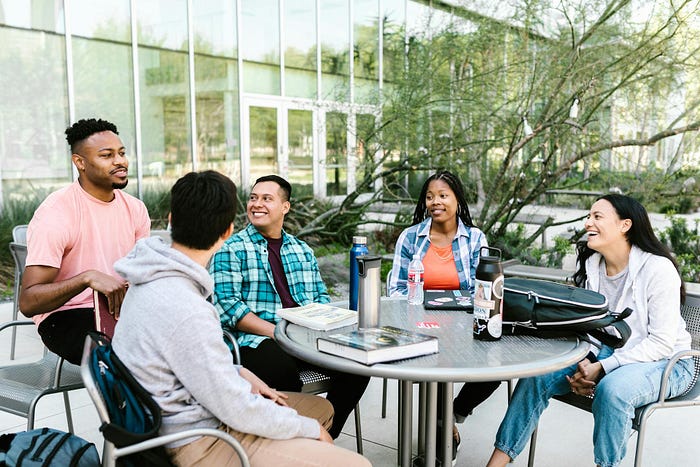
AI tutors offer 24/7 availability, infinite patience, and personalized feedback. Virtual conversation partners claim to simulate native speakers perfectly. Marketing materials showcase learners achieving fluency through the use of algorithms. AI apps promise you fluency in 30 days.
It looks as if we no longer need professional teachers or human communication partners.
Honestly, when I see Facebook ads like this, I go bonkers and feel sorry for the learners who give their money away, naively believing that an AI app will finally eliminate their pain and make them fluent in just 30 days.
There is one important detail missing from this idyllic, nicely promoted scenario.
Language isn't a simple tool for information transfer.
Language evolved so that humans could connect, share stories, comfort one another, argue, laugh, dream, and survive together. It's the medium through which we share our thoughts, negotiate meaning, and build relationships.
The Beautiful Chaos of Real Conversation
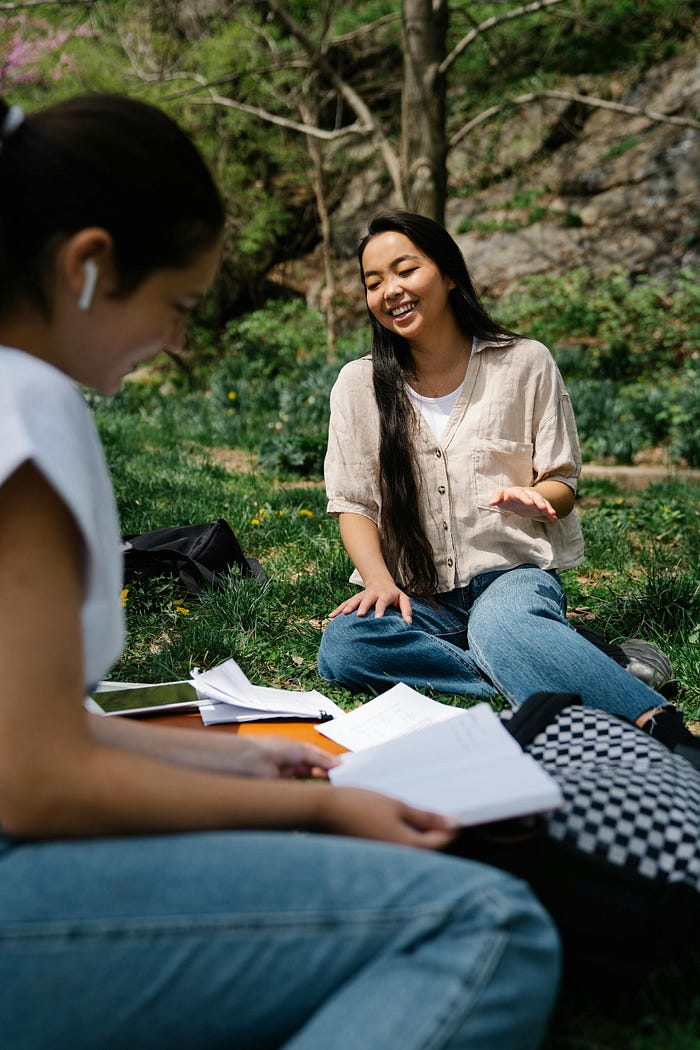
Real conversations unfold with such stunning complexity that no algorithm can fully replicate. At least not now.
We often take casual conversations and simple, daily interactions for granted. But it's astonishing to me how much happens when two minds meet through language.
Think about your last conversation and all the spontaneous topic shifts, interruptions, cultural references with shared background knowledge, emotions, and the constant negotiation of meaning. We are checking comprehension, confirming, and modifying language to make our points clear.
Let me show you how much is going on in a short, adapted from my memory, conversation between me (Swedish teacher) and my student from Afghanistan, with annotations to show conversational dynamics:
Viktoria (Swedish teacher): So, how was your Nowruz? Did you celebrate with your family? [open-ended question, cultural reference]
Omid (Afghan student): Yes! We cleaned the house, cooked sabzi polo, and my aunt jumped over the fire. [cultural reference, humor]
Viktoria: Wait, jumped over fire? Like literally? [surprise + clarification request]
Omid: Yes, it's part of the Chaharshanbe Suri tradition. It's like… you jump to take bad luck away. [cultural explanation]
Viktoria: That's wild. We don't have anything that exciting. We just… eat herring. [cultural comparison, understatement, humor]
Omid: Always herring? Why herring? [comprehension check + curiosity]
Viktoria: Well, at almost every Swedish holiday, Christmas, Midsummer, Easter, you'll see a table with boiled potatoes, crispbread, and three kinds of pickled herring. [cultural norm explanation]
Omid: That's like our rice with everything. But what's that smelly fish I saw in a video? The one they open outside with gloves? [cultural reference + clarification request]
Viktoria: Oh… that one. That's surströmming. It's fermented Baltic herring that smells like a mix of rotten eggs and dead dreams. [humor, cultural detail]
Omid: [laughs] Dead dreams! Why do you eat it then? [humor, comprehension check]
Viktoria: Some people say it's a delicacy. Others say it's a dare. Even Swedes open the can outdoors because it can literally explode. The smell is so strong that airlines have banned it. [cultural fact, exaggeration + humor]
Omid: So it's like our sheep's head dish, pacha. Tastes better than it looks, but… traumatizing the first time. [cultural comparison + humor]
Viktoria: I love that. Every culture has a dish that scares children and tests friendships. [emotional bonding, cultural empathy]
This dialogue is just for demonstration purposes. I wanted to show you that if we strip away the spontaneity and unpredictability of authentic human interaction, we remove the very conditions that make communication meaningful.
The Wisdom of Wandering Conversations And Why I Was Wrong About 'Wasted' Time
When I first started taking Spanish classes with online tutors from Latin America, I expected a structured approach, because this is how I usually teach. In my classes, a portion of the lesson usually focuses on grammar, another on vocabulary, a listening task, a few themed speaking tasks, and then a short writing task, either in class or as homework. But what I got instead from my teachers were stories. Long ones. But so interesting!
One tutor from Bogotá spent half our class explaining how the city is divided into six "estratos". These are the regions that show your social class. He told me how the government tries to mask inequality by painting poor neighborhoods in bright colors.
Another tutor from Venezuela described how millions of people had fled the country because of the political and economic crises. She shared the harsh reality of hyperinflation. One US dollar, which once cost a couple of bolívars, now costs over 250,000. People work for a few dollars a month now. It costs more to produce the paper than the money is worth.
At the time, the teacher voice inside my head told me, "We're wasting our precious class time. This isn't focused learning. I'm mostly listening, I need to speak more myself".
It was incredibly selfish of me to think that way. After all, I was learning tons, and I was listening with the curiosity of a child.
Years later, I realize those "irrelevant" and free-flowing conversations became the strongest catalysts for my fluency. I still remember those conversations after many years, which weren't scripted dialogues from textbooks but authentic human experiences full of pain, genuine emotions, and reflections on their current reality. It was like a guided tour into their culture and private life.
If only they knew now what a profound effect their stories had on my learning. I absorbed vocabulary for economic concepts (devaluación, hiperinflación), urban planning (estratificación social), and political commentary (crisis migratoria) in contexts that made them unforgettable.
Apart from developing vocabulary in context, I sharpened my pragmatic competence (using language appropriately in social contexts) and cultural knowledge, the norms and expectations of Latin American countries. Those meandering conversations gave me all of that simultaneously, in ways no structured exercise could bring.
Yes, I agree that AI can provide valuable practice opportunities, but it cannot replace authentic human interaction. Only through real and emotionally rich conversations do you develop social intelligence and communicative competence.
So no, those hours in my private classes weren't wasted. They were precious, and I'm so deeply grateful for those moments of genuine human connection.
Next, I want to give you some examples of activities for making your communication meaningful and human in your target language.
10 Science-Backed Strategies for Human-Centered Learning
As Gass and Selinker (2008) argue, learners acquire language most effectively through meaningful input and opportunities to produce output in context.
So how do you transform conversation into deliberate practice without losing its natural flow?
1. Retell and Reframe Stories
Repetition with variation deepens learning. When you retell something in your own words, you're engaging in "pushed output". You stretch your cognitive resources and activate dormant vocabulary (Swain, 1995).
- After your conversation partner shares a story, summarize it using simpler words
- Retell the same story as if it happened to you personally
- Switch perspective and narrate it from another character's viewpoint
- Challenge yourself to use different grammatical structures each time
If your Italian tutor describes a chaotic family dinner, first summarize the basics, then retell it as your own experience ("Yesterday MY family had this crazy dinner…"), then from the grandmother's perspective.
2. Paraphrase Challenging Texts
Confronting complex language pushes you beyond your comfort zone. Complexity fosters deeper processing and mental engagement (Dörnyei & Ryan, 2015).
- Take a challenging paragraph from news, literature, or song lyrics
- Paraphrase it aloud using everyday language
- Replace sophisticated vocabulary with simpler synonyms, then retell
For example, transform a formal news article about economic policy into casual conversational language, then discuss the same topic as if explaining it to a friend.
3. Engage in Debates on Real Issues
I always have debates in my teaching curriculum. They are fun, and my students never want to leave when the lesson is over. They keep having a heated discussion. Their genuine engagement makes me feel so happy.
Argumentative conversations trigger rapid negotiation of meaning and force you to mobilize incomplete linguistic resources under cognitive pressure (Gass & Behney, 2020). This type of interaction speeds up vocabulary activation and pragmatic awareness.
- Choose controversial topics relevant to both cultures (e.g., urban planning, education, technology). For example, debate whether cities should ban cars from downtown areas, using your conversation partner's city as a case study.
- Prepare three key arguments before the conversation
- Focus on responding quickly rather than perfectly during discussion
- Practice graceful disagreement and evidence presentation
- During discussion, focus on responding quickly rather than perfectly.
4. Practice "Ping-Pong" Exchanges
Fluency depends on the speed of turn-taking. Littlemore (2023) emphasizes that communicative competence involves managing interruptions, clarifications, and backchanneling.
- Pick a theme (e.g., food, travel, hobbies).
- Partner A asks a quick question, Partner B answers in one or two sentences.
- Partner B immediately follows up with another question.
- Keep the rhythm going for 3–4 minutes without pausing.
For example, "What's your favorite comfort food?" → "Pasta with my grandmother's sauce. What food reminds you of home?" → "Apple pie from our local bakery. Do you cook traditional dishes yourself?"
5. Anchor Vocabulary in Personal Narratives
Words become memorable when they're connected to lived experience. Hedge (2000) stresses that meaningful, personalized tasks make vocabulary memorable.
- Immediately after learning new vocabulary, create three sentences about your own life
- Share the most interesting sentence with your conversation partner
- Use the word again within the same week in different contexts
- Connect abstract concepts to concrete personal experiences
6. The Collaborative Story Builder
Improvisational tasks promote creativity and push learners beyond prepared speech into spontaneous language generation (Hedge, 2000).
- Start a story with two sentences.
- Your partner continues for two sentences, then you take over again.
- Focus on keeping the story coherent while stretching vocabulary.
Example: "Maria walked into the empty café at midnight. The chairs were stacked on tables like sleeping giants." → Partner continues the mystery.
7. Shadowing with Personalization
Shadowing (repeating what you hear in real time) builds pronunciation and rhythm. Littlemore (2023) notes that combining imitation with personal adaptation accelerates fluency because of deeper cognitive engagement.
- Listen to a short dialogue or podcast excerpt.
- Shadow the words immediately.
- Then adapt. Replace key details with your own life events.
Let's say you shadow a dialogue about weekend plans, then transform it using your actual upcoming weekend activities.
8. The Cultural Ambassador Challenge
Language is inseparable from cultural knowledge (Dörnyei & Ryan, 2015). Explaining your own culture in the target language builds pragmatic competence.
- Prepare informal 2–3 minute presentations about your cultural practices
- Present spontaneously without scripts or notes
- Invite questions and respond to cultural comparisons
- Practice explaining concepts that don't exist in your partner's culture
For example, explain American "tailgating" to a German partner, then field questions about why people eat in parking lots before sports events.
9. Clarification Drills in Real Time
Gass and Selinker (2008) emphasize the role of clarification and confirmation in interaction. Training yourself to ask and respond to clarification requests boosts conversational resilience.
- Master clarification phrases: "Do you mean…?", "So you're saying…?", "Could you rephrase that?"
- Practice interrupting politely when confused
- Learn to paraphrase others' statements for confirmation
- Develop natural repair strategies when communication breaks down
When your partner mentions "bureaucratic red tape," interrupt with "Sorry, what do you mean by red tape? Is that like paperwork problems?"
10. Emotional Storytelling
Memory strengthens when emotion is involved (Hedge, 2000). That's because the amygdala is activated, which creates more durable language memories. And retelling experiences with emotional detail builds expressive range.
- Choose personally meaningful memories (embarrassing, triumphant, frightening, joyful)
- Tell stories with deliberate emotional expression (tone, gestures, vivid details)
- Encourage your partner to retell your story using their own words
- Practice expressing complex emotions and reactions authentically
For example, dramatically recount your most embarrassing job interview, then have your partner retell it from the interviewer's perspective.
Conclusion
Yes, there's no doubt, AI will continue to advance. Machine learning models will become more sophisticated, and chatbots will simulate human interaction with better accuracy. But they will remain simulations, a sophisticated pattern matching without the consciousness, cultural memory, and emotional depth that make human communication so powerful for language learning.
My Venezuelan tutor, who shared her family's economic struggles, wasn't just providing vocabulary practice. She was also offering a glimpse into her own life, into her resilience. The Colombian instructor explaining social inequality wasn't delivering a cultural studies lecture. He was sharing his lived reality.
These moments of genuine human connection transform language learning from mechanical skill acquisition into profound cultural exchange. They teach us not just how to communicate, but why communication matters.
No algorithm can replicate the cultural intuition of lived experience, or the emotional resonance of shared human stories. And that's exactly why, despite all the technological promises, the most profound language learning still happens in the old-fashioned way — through human story and connection.
Thanks for reading!
- If you find my work helpful, follow and subscribe on Medium
- Follow this newly launched publication Language Mind
- Subscribe to my newsletter on Substack for exclusive posts
- Buy me a coffee if you'd like to support my work ☕
You might also like these stories:
References
- Dörnyei, Z., & Ryan, S. (2015). The psychology of the language learner revisited. Routledge.
- Gass, S. M., & Behney, J. (2020). Second language acquisition: An introductory course (5th ed.). Routledge.
- Gass, S. M., & Selinker, L. (2008). Second language acquisition: An introductory course (3rd ed.). Routledge.
- Hedge, T. (2000). Teaching and learning in the language classroom. Oxford University Press.
- Littlemore, J. (2023). Applying cognitive linguistics to second language learning and teaching. Cambridge University Press.
- Swain, M. (1995). Three functions of output in second language learning. In G. Cook & B. Seidlhofer (Eds.), Principle and practice in applied linguistics (pp. 125–144). Oxford University Press.